Skip navigation

Sitting at the Tavern tonight, I was talking about potential street vendor breakfast foods with a friend and came up with an idea or two for waffle “hot dogs.” My favorite idea was a condiment, a strawberry relish with mint to put on waffles. There were two issues with my idea. 1st, the only thing I knew about relish is that pickle relish is chopped pickles used in egg salad, tuna salad, potato salad, etc…. 2nd, I’ve never made a relish so I wasn’t sure what I should use to balance the flavors. A quick google search took me to the wikipedia page for relish, which explained:

relish is a cookedpickled, or chopped vegetable or fruit food item typically used as a condiment in particular to enhance a staple. It originated in India and has since become popular throughout the world. . .. The item generally consists of discernible vegetable or fruit pieces in a sauce, although the sauce is subordinate in character to the vegetable or fruit pieces. It might consist of a single type of vegetable or fruit, or a combination of these. These fruits or vegetables might be coarsely or finely chopped, but generally a relish is not as smooth as a sauce-type condiment, such as ketchup. The overall taste sensation might be sweet or savory, hot or mild, but it is always a strong flavor that complements or adds to the primary food item with which it is served.

With this explanation in mind, I set out to make a relish. For the sauce I decided to use balsamic vinegar and maple syrup. I figured this would give the flavor profile we expect with waffles but provide a little bite and depth. I added a little mint to the sauce and then I finely diced up the strawberries adde some mint to the berries and mixed it all together. The taste was fantastic. It was sweet, maple-y, had a little bit of an acidic bite and left a minty taste in my mouth. Here’s a picture:
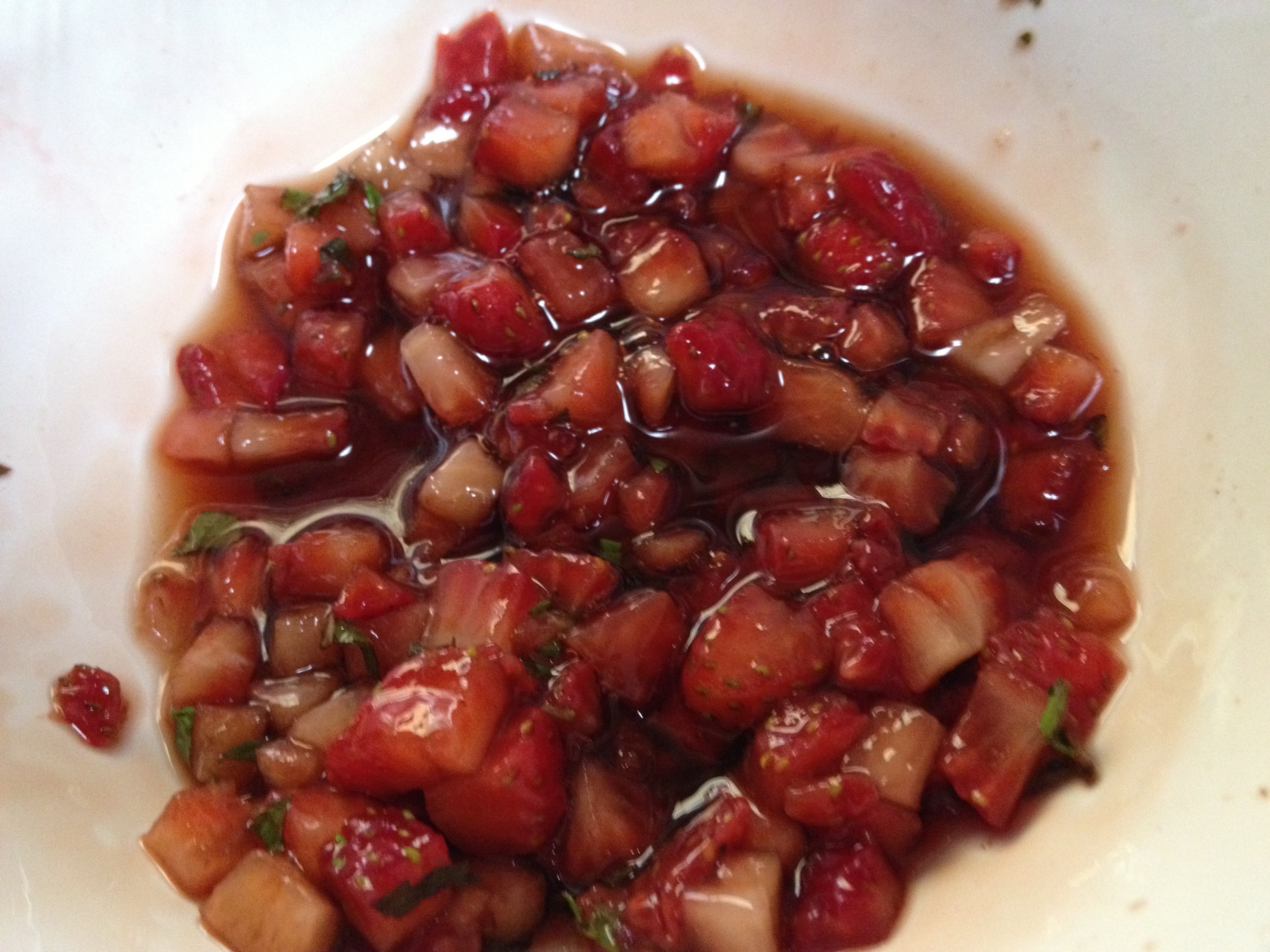
Strawberry Relish

After I made the relish I rolled out a breakfast sausage hot dog and cooked it up, being lazy, (and since it was 1am) I popped a waffle in the toaster; finally I compiled wrapping the waffle around the sausage and topping with my strawberry relish and whipped cream. It was tasty.

Interested in the recipe? Here’s what I did:

2/3 cup of finely diced strawberries

1 TBSP of Maple Syrup (I used Grade B)

1/2 tsp of Balsamic vinegar

chopped mint (I used 4 or 5 leaves in the strawberries and 2 in the sauce)

in a bowl mix balsamic and maple syrup. chop and crush fresh mint leaves and mix in with the maple-balsamic mixture.

Next mix the rest of the chopped mint in with the diced strawberries

Finally pour the sauce over the strawberries and mint and mix

It’s fresh and minty with a rich maple flavor. You can use it right away or you can put it in the refrigerator over nigh and really let the flavors meld.

Give it a try.
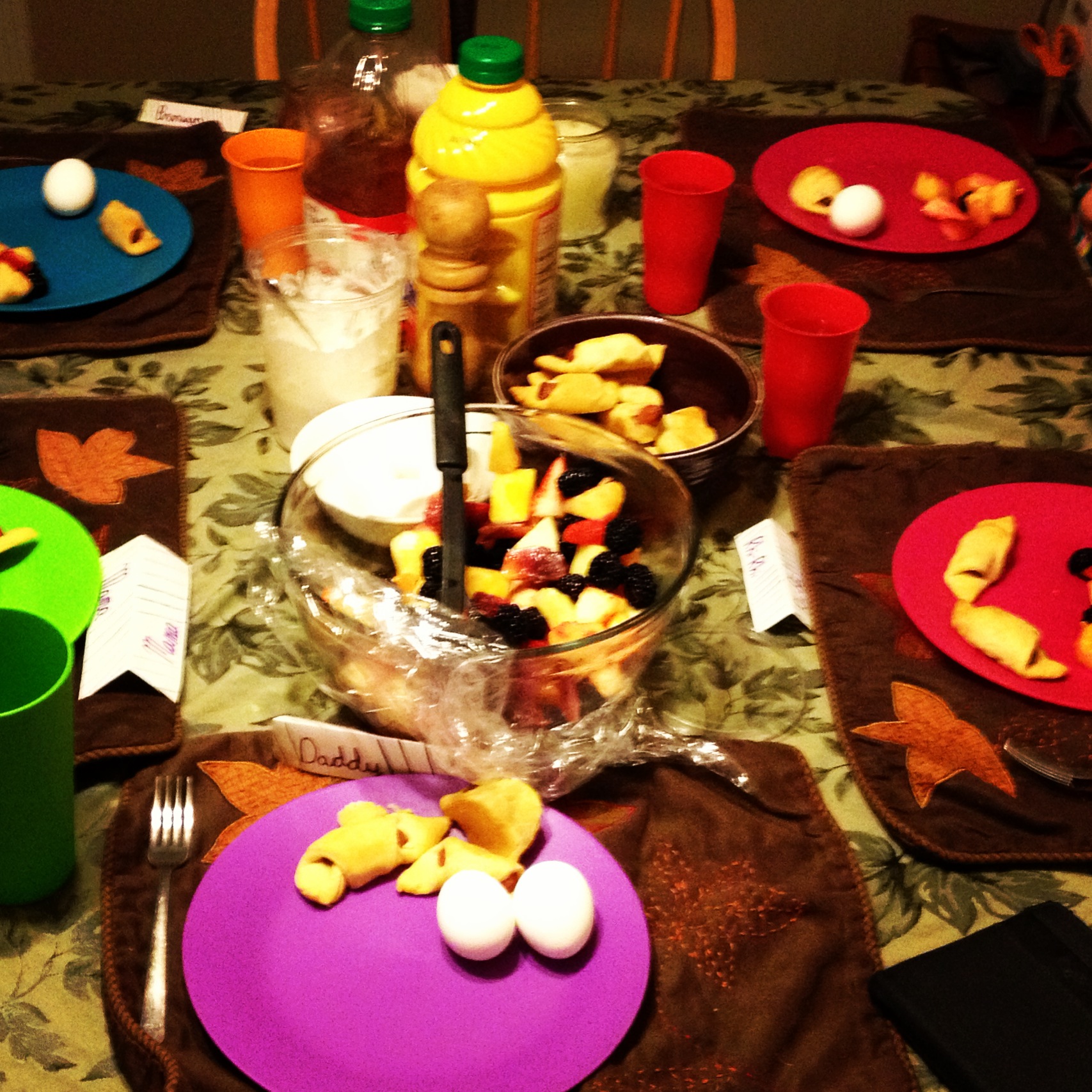
Over the past several years, my Baptist family and I have practiced the observance of the Lenten season. While normal for a large part of Christendom, it’s not really the norm for the Baptist tradition from which I come. Every year so far, our family Lenten sacrifice has centered around food so this year my wife suggested a change. Rather than give up something, she wanted to add something that would be sacrificial. After some thought, we decided to add a family meal around the table. Now some of you may think that this is no sacrifice, but in our world finding time to eat around the table together every day is a struggle. The meal we decided on is breakfast because we are all home at 6:30 in the morning (except on gym days when its closer to 7). What we eat has been different, Crepes, pigs in a blanket, fruit salad, french toast…, but the practice has been consistent. The family gathers and 2 people read from the lectionary readings for the day (1 OT 1 Gospel) and then the collect for the week is read. I really like listening to my children read scripture in the morning. I also like that the tv is off until everyone is off to school. Who knows this sacrifice might have to stay around long after Lent ends this year.2013-02-14 07.38.10
This is Breakfast on Ash Wednesday.

2013-02-14 07.40.56
This is Breakfast from Valentines Day

That magic time of year has come. A time when temperatures dip, the fair comes to town, guys in pee wees, high school, college and pros strap on the pads, and stew simmers gently on the stove top.

Today saw all of those things come to fruition. After a cold front assaulted the Big Country the temperature dropped from the sweltering 105* high yesterday to a lovely 66* this morning. UMHB kicked of their football season with a 34-7 victory over Kean University; and a trip to the farmer’s market brought bell peppers, jalapeno’s, banana peppers, pears, red onions and butternut squash, the latter of which made a costarring appearance in dinner tonight. I love this time of year, and I love it more when the temps dip into the 50s and stay for a while, but one step at a time.

Next weekend brings another cold front, andfor those of you looking for a soup to make when the temperature drops here is a recipe for tonight’s dinner:

A fantastic choice for a cool evening when stew or soup sound yummy.

Butternut Squash and Beef soup

Ingredients:

3 slices of thick cut bacon diced

2 Tbsp Butter

1c each diced onion, carrot, celery, bell pepper

3 cloves of garlic minced

1-2 Roasted Butternut squash (I used a little less than 1 1/2) cut into 1-2 inch cubes

2 lbs of beef cut into 1 1/2 inch cubes (I cubed country style beef ribs) and remove most of the fat

4 sprigs of fresh rosemary

fresh thyme ( I used 2 stems appx 4″ long )

56 oz of chicken stock (I used HEB reduced sodium)

salt and fresh ground pepper to taste

Instructions:

Preheat oven to 400*

1/4 and remove the seeds of the butternut squash

brush with Olive oil and sprinkle with pinch of salt

When the oven is ready, place squash on a half sheet pan and roast in the oven for 25 minutes or until beginning to soften

when finished cut off the peel and cube

In a large dutch oven over a medium heat, brown the bacon and render the fat

When the fat is rendered, add 2 Tbsp of butter and melt

Next add the onions, carrots, celery and good pinch of salt and cook them until the celery begins to become translucent

Remove the veggies to a bowl

Next, brown the beef in the dutch oven seasoning with salt and ground pepper

When the meat is browned and the beef fat is beginning to render, add back the veggies, add the garlic, the fresh herbs,  the bell pepper, the stock and finally the butternut squash

Stir everything together and turn up the heat to high

Bring the soup to a boil and lower the temperature to simmer

Simmer until beef is tender, tasting and adjusting the salt and pepper levels to taste


We served the soup with a loaf of hot ciabatta bread and I added hot sauce because I like a little spice. The butternut squash served as the starchy element in the soup and added a subtle sweetness to it. It tasted a bit like sweet potatoes. All in all, it was a lovely hearty soup, and truth be told, I could dring the broth by the gallon.

Good Eating friends

So, maybe the title is a little misleading. This post really has nothing to do with the Catholic Church, though it is the church of choice in much of Louisiana, and it has nothing to do with the coming apocalypse directly, though one could argue it talks about the best forum for preparing people, shared food. Instead, this post is actually about one of my favorite foods, Jambalaya, and what one can do with the left overs.

I actually make Jambalaya so that I will have left overs because what do I like more than Jambalaya? Jambalaya casserole, I know that it may sound strange, but Jambalaya Casserole is a dish I threw together one day because I had tons of left over Jambalaya and a few staples in the cupboard, and I needed to feed a family of five. After baking the gooey delectable and adding a slab of freshly baked french bread, we had a warm and hearty, stick to your ribs kind of comfort meal. The kind of meal that was designed for sitting around the table with those you love and sharing life.

If you’ve read any of my recent posts,you have probably gleaned that one of the most important aspects of food for me is the ability it has to create and foster community. My fondest memories usually have something to do with food. The best example I can give is that Papa Hap (my brothers grandfather) and I used to hike in the mountains and pick huckleberries that were used by Nanny (Papa Hap’s wife) and my Granny to make huckleberry pies and cobblers. Before we would leave, we would eat breakfast and read the passage from the day’s Our Daily Bread; we would drink a cup of coffee; and then we would pack our lunch, which usually consisted of a pack of crackers, a slab of whatever cake Nanny had in the kitchen and a can of sardines, deviled ham, or potted meat. (I said my fond memories were associated with food, I never said all the food was good.) After packing up we would take an old juice jug and go up to a mountain spring and fill it up, then we were off on the days adventure. I grew to love the outdoors because of my huckleberry picking excursions with Papa Hap, and the time in the kitchen watching Granny turn berries into a cobbler with a flaky golden crust just made me want to learn to cook more.

Food is the forge on which relationships are formed. Family dinners, neighborhood bbqs, church socials, even school lunch times are places we learn to be social and develop relationships around something other than our vocation. This week I’ve spent time in the kitchen with my oldest teaching her how to put together Jambalaya and how to make my quick chili. Not really giving her a recipe, but talking about what goes in to the pot and how much. The food she creates won’t be the same as mine; it will be her own creation. It will be her art, her craft, presented to our family with love. That interchange of giving is brought about because cooking together slows us down long enough to develop a deeper relationship than sitting and watching tv.

Jambalaya

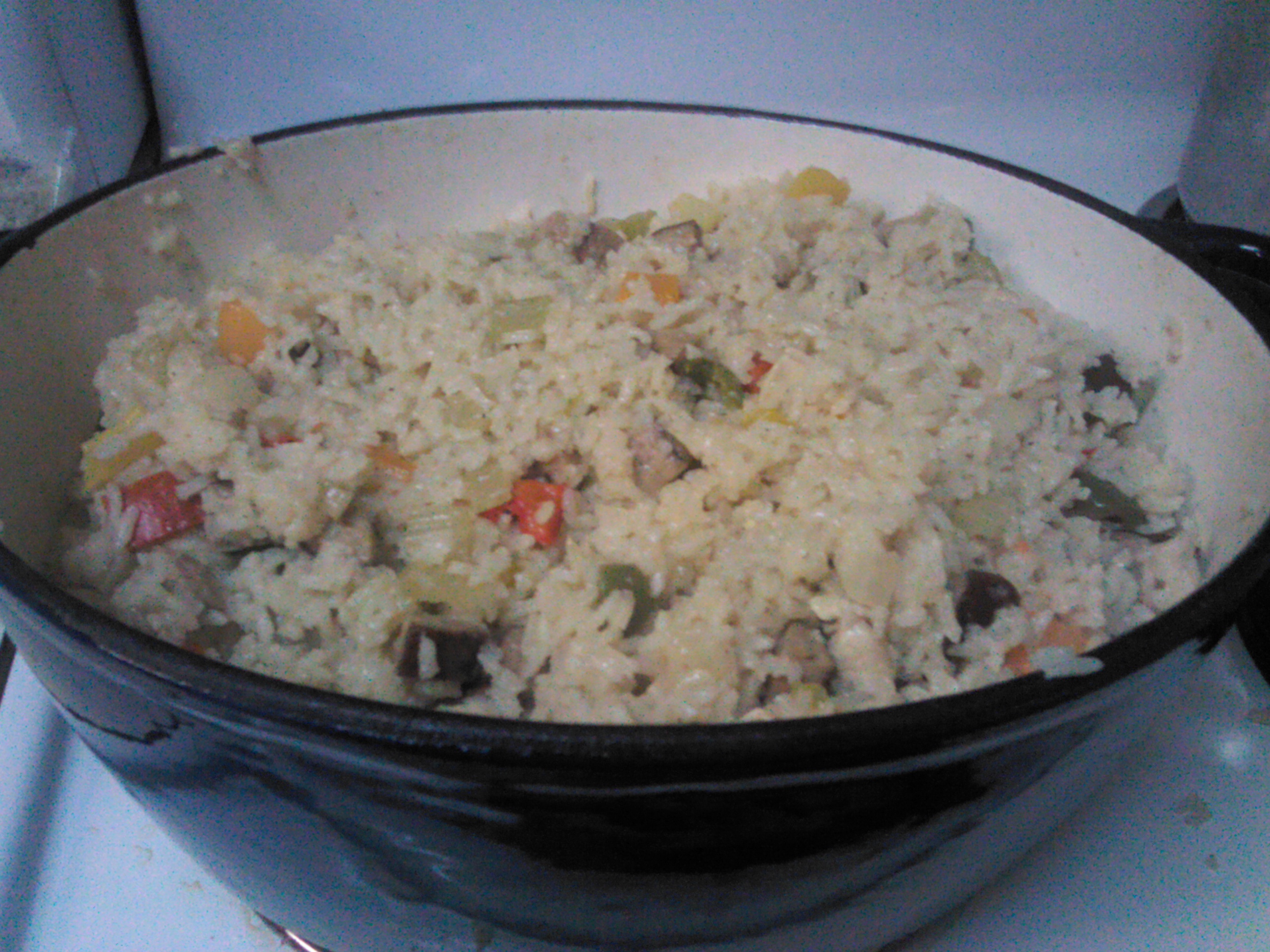
Well this is what we created for dinner, Jambalaya. I used to make this from a box, then I realized that other than being a little labor intensive, it is super easy to make. I like to minimize the number of dishes i use so i move things in and out of my dutch oven for prep, but use as many pans as you need.

Recipe:

Ingredients

4 cups of rice (I use long grain white)

2 cups onion, diced

2 cups Bell Pepper,diced (I mix colors, it’s prettier)

2 cups celery, diced

Meat (I really like the HEB chicken Andouille Sausage. I use 3 sausages diced and an equal amount of diced cooked chicken breast)

8 1/4 cups of chicken stock (I use both homemade and box stocks)

Seasonings (I don’t give actual measurements because people like different things so season to taste with salt, pepper, garlic and onion powders, cayenne pepper, cumin or make life easier and use some Creole Seasoning)

Prep:

In a pan, cook the chicken breast. (I cook mine in the dutch oven in butter.) when finished add the sausage and cook until they start browning. When cooked remove and set aside.

Next, cook all of the vegetables together until the celery and onion are translucent and the peppers soften. Remove them and set them aside.

Finally, melt 2 tbsp of butter in the pot and add your rice. Stir rice until coated with butter.

Once coated, add the vegetables, chicken and chicken Stock to the pot and mix.

Bring the stock to a rolling boil (add seasonings while you are waiting)

Cover, Reduce heat and simmer covered for 20 minutes.

After 20 minutes, check the pot, the rice should be fully cooked  and the Jambalaya should be done. If the rice is not finished, cover and remove from heat. Check again in 5 minutes. When the rice is cooked, the Jambalaya is ready. mix the rice to fluff and better distribute the meat and veggies and serve with some nice hot bread.

That’s all there is to it. Give it a try. As you can see, it makes plenty, so its a great dish to share or to horde so you have the left overs to make Jambalaya Casserole. (Recipe to come)

Today was Pentecost Sunday. For those whose faith tradition doesn’t follow the traditional church calendar. Pentecost Sunday is the celebration of the coming of the Holy Spirit on the day of Pentecost as told in Acts chapter 2. The sermon this morning was stellar, and at the end of the service our church said some goodbyes as some are graduating and leaving for good while others are going for the summer.

Goodbyes are a common part of life at Crosspoint Fellowship. In the nearly 8 years I have been a member, I have seen dozens of people enter and leave our fellowship because our community attracts people who ask questions or need a respite for their faith life. The result is Crosspoint is usually filled with college students and seminary students, and that typically means transition in a few short years. This year is no different, a couple who have served in leadership for 3 years are off to pursue the ministry to which they have been called, another member will be off to Paris and another of to Africa. Odd as it may be to most churches, it is what defines “normal” at Crosspoint.

The beautiful thing about this type of normal is that it exemplifies what happened at Pentecost. The whole world, represented by the plethora of nations in Jerusalem, was unified by the coming of the promised comforter, The Holy Spirit. Everyone heard the sermon offered by Peter in their own language. The Gospel message of Jesus’ life, death, and resurrection, which defeated death, was available to all equally, and the visitors who were added to the number took that message with them as they went. Such is the life of Crosspoint. People from various walks of life are unified by One Holy Spirit and take the Gospel with them as they go out from our community.

In order to reflect this idea f unity on Pentecost Sunday, I opted to bake bread for use in communion. This isn’t an abnormal thing at Crosspoint. We have a number of folks that enjoy baking and sharing it with the community and communion bread is one of the many items that gets made. What was a little different was that today I baked a gluten free loaf of bread.

I don’t normally bake gluten free, and one friend even asked me not to perpetuate the myth of gluten allergies by baking gluten free this week, but I baked gluten free bread this week for the purpose of expressing our unity in the One Holy Spirit. Whether or not there is such a thing as a gluten allergy is irrelevant in my mind. We have people who come to our church that don’t eat gluten; who take communion from a plate each week that is different from that of the rest of the community. I figured if ever there was a day everyone should be partaking of the same loaf, it was Pentecost, and so I baked gluten free bread for the first time.

In order to make the bread, I scoured the net for recipes. Once I had found one I liked I headed for the store where I discovered that buying all the ingredients was not economically expedient, so instead, I found a gluten free bread mix. I don’t normally hock items on my food blog because I would prefer it be about the food, but this mix was pretty awesome and the recipe was very easy. And since I had people asking about it, I’m giving the shout out to Pamela’s Products Gluten-Free Bread Mix & Flour Blend. The bread came out awesome. During the hour that it rested after mixing, the yeast really went to work and by the time the cooking was done, the loaf was luscious and golden brown. It was far better than I expected.
Owly Images
Best of all, our community had the chance to visually express the unity we have in the Holy Spirit by partaking of a common loaf for a people equally called by God.  Ironically, none of Crosspoint folks who maintain gluten free diets were in church today. I guess it really is the thought that counts.

For the last 10 years or so I have made the claim that is ordained by God. The origins for this claim can be found in a Deuteronomic History class I had as an undergrad in which the Professor painted a glorious picture of the Old Testament sacrificial system as a fellowship meal between God and God’s people. After some searching of my own through the Torah, I realized that it wasn’t the entire sacrificial system that painted this picture, but that the picture is indeed painted and nowhere better than in the 14th chapter of Deuteronomy.

22 Be sure to set aside a tenth of all that your fields produce each year. 23 Eat the tithe of your grain, new wine and olive oil, and the firstborn of your herds and flocks in the presence of the Lord your God at the place he will choose as a dwelling for his Name, so that you may learn to revere the Lord your God always. 24 But if that place is too distant and you have been blessed by the Lord your God and cannot carry your tithe (because the place where the Lord will choose to put his Name is so far away), 25 then exchange your tithe for silver, and take the silver with you and go to the place the Lord your God will choose. 26 Use the silver to buy whatever you like: cattle, sheep, wine or other fermented drink, or anything you wish. Then you and your household shall eat there in the presence of the Lord your God and rejoice. (NIV)

I’ve always found this text interesting on a couple of levels.  First, it demonstrates an aspect of tithing that I never heard of in church growing up. The tithe offered here is not merely a surrender of 10% of what was produced. it is a sharing of what has been produced by the joint efforts of the family and God. Tithing in this passage is participatory. It is a thank you to God for provision and party to celebrate the increase. Look at the instructions:

 if that place is too distant and you have been blessed by the Lord your God and cannot carry your tithe (because the place where the Lord will choose to put his Name is so far away),  then exchange your tithe for silver, and take the silver with you and go to the place the Lord your God will choose.  Use the silver to buy whatever you like: cattle, sheep, wine or other fermented drink, or anything you wish.

The purpose of this tithe is to celebrate the community we share with God and what has resulted from it. That is very different than dropping 10% in the plate on a Sunday, and it is also one of the reasons I like to bring food to share with my community of faith. They are my faith family enjoined with my physical family in the work God has called us to share in. The natural out pouring of this relationship in my mind is a participatory tithe with my community of faith.

The second reason this text peaks my interest is that it paints a beautiful picture of an intimate relationship between God and and God’s followers, a picture I think is recreated when families and friends gather around the yard or park for a BBQ. Take a moment to think about what BBQ is and what goes on during a family BBQ.

By definition, BBQ is the slow roasting of meat over low heat. Different regions have different preferences for meat and types of sauce, but common to all is a long cooking time during which there is ample time for fellowship of all types. Sitting around the BBQ pit/grill is perfect for reminiscing, talking about the future, celebrating a birthday, or mourning a loss in the family. When we BBQ we do far more than eat. We share ourselves, we share our possessions, we share our families and lives. BBQing  with people is not just dining; its an honor because it lets you in at a level not everyone is allowed to experience.  BBQing slows life down to a pace that allows us to celebrate the life we have with those we love and for a moment reorder our lives so that the world takes a back seat to our relationships.

This is why I see the tithe in Deuteronomy 14 as a BBQ. It is a process in which people are forced to slow down to a pace at which they can commune with God. It is not fast like grilling burgers or hot dogs, its time consuming and places things back in their proper place. The focus is no longer on the toil and stress brought about by production but on God and the relationship that blessed that stress and toil.

One of the beautiful things about food it that it draws us together, and there is something sacred about sharing life. Jesus said the two most important Laws in the Torah are love God with all of your heart and Love people as you love yourself; that all of the Laws are built on these two things. When we feast, when we celebrate, when we BBQ, we share in the sacred part of life on which God built the Law as we create the community for which we were created.

I hope you find some time soon to get together with your friends and family and share life together. BBQ don’t just grill, or if you choose to grill burgers and hot dogs, take the time to stretch the experience. Let the event slow you down so you can fully experience that sacred part of our lives. To help, follow the link to a recipe I posted in 2010 of a BBQ Sauce I created.

https://preludeandcoda.com/2010/09/19/tried-something-new-a-bbq-sauce/

Since it came up in church last week I have decided i will start using my blog again, hopefully more frequently than in the past. I need to write regularly and since school is behind me now, why not here?

My plan is to write about my theology of food. Having a theology of food may sound strange, but I would argue it flows naturally from both scripture and our theology of humanity. Scripture is replete with references to food. Worship practices were formed around animal sacrifice and feasting, and communion is participation in a meal. For humanity, food is about community not simply nutrition. We have a love affair with food. Food evokes memories and emotion. My fondest memories are of family gatherings in Alabama where food was the tableau on which the celebration of life was set. So I have a theology of food. That theology is why I make foods for church on Sunday mornings and its why I sit and eat with friends when ever I have a chance. I believe it helps to form us physically and spiritually.

So, I invite you to read along as I post recipes and discuss my theology of food, and it would be fantastic if you joined in the conversation.

Anyone who knows me well has probably had a bowl of my quick chili. My quick chili is a recipe I developed in Utah that utilizes a combination of canned and fresh foods seasoned to remind me of Texas. Tonight, since I haven’t been to the grocery store recently and the bank account would not allow eating out, I had to fix dinner with what we had in the pantry. Chili is always a go to for me because i can have it on the table in half an hour, but since the family is meat free during lent, I had to be creative. The answer? Red Lentil Chili over rice.
Having never cooked lentils, but having tons of them in the pantry, I looked up a how to on the web and promptly did my own thing anyway. I rinsed and cleaned the lentils; covered them with water; brought them to a boil; and then added most of my quick chili “fixins.” After tasting everything and adjusting seasonings I realized that lentils, chili beans and tomatoes, while tasty, don’t have a substantial mouth feel, and needed a boost to be meal worthy. Since I work in a Chinese restaurant, I ran to work and picked up some steamed rice. (It took less time than making it.) The combination worked well, and other than having too much in the bowl, all was well for dinner.

Red Lentil Chili and Rice

    :
    Red Lentils (cleaned of debris and rinsed)
    2 cans of diced chili tomatoes
    2 cans of chili beans
    Chili powder
    Onion powder
    Garlic powder
    Salt
    Fresh Ground Pepper
    Cumin
    Nutritional yeast
    Rice

    Prepare rice according to the directions

    In a large pot or deep skillet (I used a 12″ deep skillet from wearever) place the dried lentils and cover with water. Heat on high until boiling then lower to a simmer. Simmer until the lentils are no longer hard, but are not tender. (Just takes a few minutes) Add canned tomatoes and beans and stir until well combined. Taste to determine the seasoning needs and then season to taste using the chili powder, onion, garlic, salt and pepper. Sprinkle on a big pinch of nutritional yeast (it adds an almost meaty flavor) and taste again. when the seasoning is right for your palate, simmer until the lentils are tender, the liquid has reduced, and the chili has thickened. just before serving stir in some cumin (around a tsp or 2) then serve it over the rice.

    I know that recipe is vague, but that is how I cook most of the time. I trust my palate. I will suggest that you try to reign in the lentils some because a little went a lot farther than I expected.

    Well, good eating.

    P.S. If you’re wondering about the title, Real Texas Chili doesn’t have beans and this is nothing but beans and a few tomatoes.

The gingerbread recipe that follows is one I discovered a few years ago on the former recipezaar.com. The recipe can currently be found at here.

I generally make this recipe for gifts or for church and when I make this recipe I pour the batter into 5 small loaf pans. Some of the comments on the site say the bread comes out dry, but I have never had that problem when making the smaller loaves. I don’t use the glaze recipe, but I left in case someone else would like to use it.

From food.com
About This Recipe
“Nice and spicy. The flavor always brings a feeling of warmth and cheer to me. The aroma is positively divine. Makes 2 loaves, one for now, and one you can wrap and freeze for later, or to give as a gift!”

Ingredients
For the Bread
3/4 cup firmly packed brown sugar
1/2 cup butter, softened
2 large eggs, lightly beaten
1 cup molasses
1/2 cup boiling water
1/2 teaspoon baking soda
2 3/4 cups all-purpose flour
2 teaspoons baking powder
1 tablespoon ginger
1 1/2 teaspoons cinnamon
3/4 teaspoon allspice
3/4 teaspoon cloves
1/2 teaspoon salt

For the Glaze
1/2 cup powdered sugar
1 -2 tablespoon milk

Directions
Preheat oven to 350°F.
Grease two 9 x 5-inch loaf pans and set aside.
In a mixing bowl, cream brown sugar with the butter until it is light and fluffy, then add the eggs and mix well.
Stir up the molasses, water, and baking soda in a separate bowl, and then add that mixture to the creamed sugar; stir until well blended.
Page 2 of 2Gingerbread (cont.)
Directions (cont.)
Add the other ingredients, one at a time, beating after each addition, alternating with the flour.
Divide the batter evenly among the two pans and bake in a preheated oven for 40-50 minutes or until it springs back when touched lightly in the center.
Remove from oven and cool in pans for 15 minutes on a wire rack, then remove the breads from the pans to cool completely on the wire racks.
To prepare glaze, mix together the sugar with the milk, adding the milk gradually until it attains a drizzling consistency.
Spread the glaze over the gingerbread when they have cooled completely.
Store gingerbread in a airtight container in the refrigerator.

My Cranberry Pomegranate Instant Oatmeal cookies were created because of a flavor of instant oatmeal available at Wal-Mart. I saw Great Value Cranberry Pomegranate Instant Oatmeal and had to try it so I bought it and took it home. The family loved it and the first time I smelled it when the kids were making breakfast I thought, “That smells like a good cookie!” I checked online, looked at a few cookbooks and asked a few people for oatmeal cookie recipes that used instant oatmeal but couldn’t find one. So I had an idea for a cookie, but I didn’t have a recipe.
To make the cookies, then, I began by using a basic cookie recipe similar to what one uses when making chocolate chip cookies. I adjusted it slightly because of the added sugar in instant oatmeal and then augmented the recipe with molasses and pomegranate flavored Craisins. I scooped the cookies onto cookies sheets with a small cookie scoop and baked at 350* until the cookies were brown and set on the sides. Total cook time ranged from 18 minutes for the first batch to about 13 minutes for the 3rd batch. To encourage experimentation I’ll separate out the basic cookie recipe.
BASIC COOKIE RECIPE:
1 cup Sugar (for recipe use ¾ cup)
1 cup Brown Sugar (for recipe use ¾ cup)
½ cup (1 Stick) of Butter or margarine, softened
2 eggs
2 cups flour
1 teaspoon salt
1 teaspoon baking soda
Vanilla extract ( I use 2 caps full)
ADDITIONAL INGREDIENTS;
5 packets (2 ½ cups) of instant oatmeal
2 tablespoons molasses
¾ of a bag of Craisins
INSTRUCTIONS:
• Preheat the oven to 350*
• In one bowl mix the flour, salt and baking soda and set aside.
• In another bowl (preferably in a stand mixer) Cream sugar, brown sugar, and molasses with the softened butter.
o I used margarine to get a fluffier cookie.
o I softened the butter for 10 seconds in the microwave.
• Add eggs one at a time mixing well before adding the next egg
• Add vanilla extract
• Mix the dry ingredients into the wet ingredients a little at a time a ( I like to add in 3 or 4 portions) until the two are mixed together.
• Using a mixing spoon stir in the instant oatmeal and Craisins
• Line a cookie sheet with parchment paper and scoop the dough in 1 – 1 ½ inch balls on the sheet 1- 2 inches apart ( I use a 1 ½ inch cookie scoop)
• Bake for 12 – 20 minutes until browned and set on the sides.

When finished my cookies came out thick and crisp on the outside, but soft and chewy on the inside. Because of the acids in the molasses reacting with the baking soda and the use of margarine instead of butter, the cookies were nice and thick. They also tasted great. Laura says I could cut the sugar even more, and I may on the next batch. The kids thought they were perfect.
I’m not sure, but I think this recipe would work with other instant oatmeal flavors as well. I’m considering trying it with cinnamon roll oatmeal. For that experiment I would use raisins instead of Craisins, butter instead of margarine, and might just have to ice them with a cream cheese frosting for good measure.